at midnight, during the voyage opening
The Ocean Departure
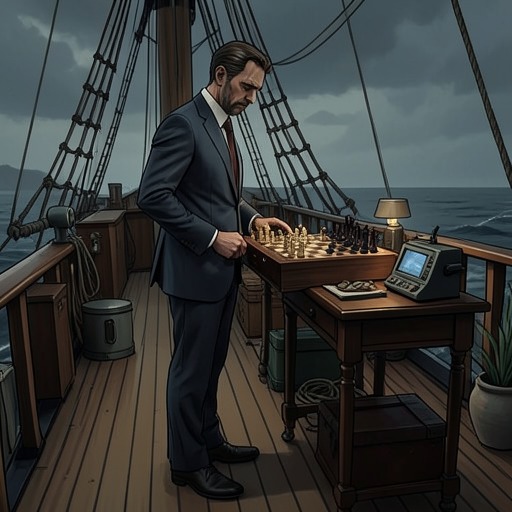
A large steamship leaves [New York](entity:location-recall-location-new-york-f84f7f10ee10) for [Buenos Aires](entity:location-recall-location-caf56b79d5c4) amid the bustle of farewell visitors, porters, and reporters. The narrator stands apart on deck with a friend when flashbulbs reveal that a celebrated passenger is aboard.
The friend identifies the celebrity as [Mirko Czentovic](entity:character-recall-character-mirko-czentovic-56cd24c6b092), the reigning world chess champion, travelling onward to new contests in Argentina. That chance discovery gives the narrator a focus for the voyage and begins his pursuit of the man behind the public reputation.
years before the voyage
The Boatman's Son
The narrator's friend recounts how [Mirko Czentovic](entity:character-recall-character-mirko-czentovic-56cd24c6b092) grew up the son of a desperately poor boatman on the middle Danube, in the rural region of [Banat](entity:location-recall-location-60dfdfbf0435). After his father dies in a collision with a grain freighter, the village priest takes the twelve-year-old into his care.
Mirko proves almost unable to learn ordinary lessons. Letters, arithmetic, and reading defeat him despite persistent help, while his dutifulness is matched by a striking lack of initiative or curiosity. The story establishes the gulf between his general limitations and the single faculty that will transform his life.
one winter evening, during Mirko’s adolescence
A Chessboard Left Behind
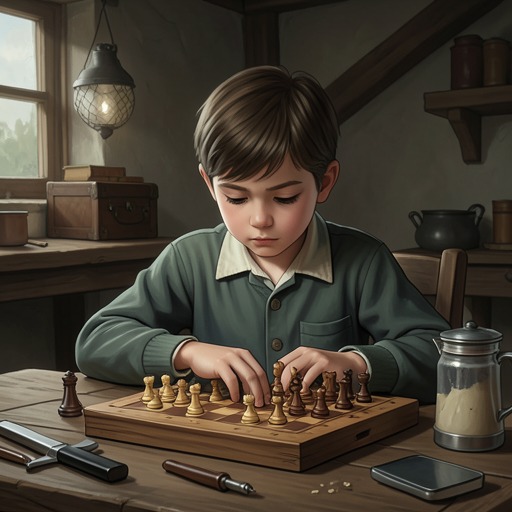
While the priest and the local gendarme sergeant play their customary chess games, a farmer arrives to summon the priest to a dying woman. The sergeant prepares to leave too, but notices that Mirko is staring fixedly at the unfinished board and jokingly asks whether he wants to take the priest's place.
Mirko accepts and defeats the sergeant twice. When the priest returns, he challenges the boy himself and is beaten with equal ease. The discovery is startling precisely because the priest knows how little the adolescent can manage in every other intellectual sphere.
the days following the first games
The Village Champion
The priest takes Mirko to a nearby town to test him against a chess club. The shy boy loses his first game because he has never encountered the Sicilian opening, but draws the next and then defeats the club's strongest players one after another.
The town's notables gather more opponents, including the elderly Count Simczic. In a packed chess room, Mirko plays for hours without looking up or speaking, beats every challenger, and then wins seven of eight games in a simultaneous contest. The local excitement turns an improbable talent into a project for the wider world.
after the town matches
Training in Vienna
A local agent offers to arrange professional chess instruction in [Vienna](entity:location-recall-location-8daae28d814e) if a year's support can be secured. Count Simczic, himself a lifelong chess enthusiast, signs the agreement after recognizing that Mirko's ability exceeds anything he has encountered.
This decision launches the boatman's son into a career that his village upbringing could scarcely have predicted. Chess becomes the one domain in which the boy's otherwise limited mind can flourish.
six months into his training
The Blind Chess Limitation
Mirko masters chess technique but cannot play a game from memory. He needs a physical board and pieces to hold a position before his eyes, even later carrying a folding set so that he can reconstruct matches and problems.
Chess circles treat this as a revealing defect: he cannot transfer the battlefield into the imagination, despite his exceptional over-the-board strength. The limitation foreshadows the narrowness of his gift, but it does not impede his rise.
from age seventeen to twenty
A World Champion
Mirko wins a succession of prizes, takes the Hungarian championship at eighteen, and becomes world champion at twenty. His cold, patient logic repeatedly defeats grandmasters celebrated for intellectual force, vision, and daring.
His success overturns the expectation that mastery must rest on broad intelligence. The chess world gains a champion whose genius is powerful but sharply confined to the board.
after his world championship
The Champion’s Greed
Away from the board, Mirko remains awkward, poorly educated, and unable to express himself in polished speech. He nevertheless sells his name for a book written by someone else, accepts commercial endorsements, and seeks out any engagement that will pay.
His colleagues mock his vulgar money-making and his unawareness of his own absurdity. Success has turned his insecurity into open pride: he regards himself as pre-eminent because he has beaten intellectuals at chess and earns more than they do.
the first days of the voyage
The Narrator’s Curiosity
The narrator admits that people consumed by a single idea have always fascinated him. Mirko seems to embody an especially extreme case: a mind narrowed to sixty-four squares, yet capable of extraordinary achievement within them.
His friend warns that Mirko carefully avoids educated company and offers no easy access to his inner life. The narrator nonetheless resolves to use the twelve-day voyage to observe the champion more closely.
the first three days at sea
The Champion Keeps His Distance
Mirko paces the promenade deck with an aloof, almost imperial bearing and rarely appears in the ship's public rooms. According to a steward, he spends most of his time in his cabin practising or reviewing games on a large board.
The narrator finds himself unable to approach without forcing an introduction. Mirko's seclusion frustrates the narrator's curiosity while reinforcing the image of a man whose life has been reduced to chess.
after three days at sea
The Nature of Chess
The narrator reflects on chess as a singular art and science: a game governed by fixed rules and a limited board, yet open to immense variation and dependent on imagination. Its apparent simplicity can call forth specialized forms of genius unlike those of other disciplines.
Mirko makes the paradox particularly vivid. He possesses a remarkable chess faculty while seeming nearly inert outside that narrow field, a “thread of gold” enclosed in dull material. The meditation deepens the narrator's desire to understand him.
after several days at sea
A Chessboard as Bait
Unable to attract Mirko through ordinary conversation, the narrator decides that the surest way to catch a chess master's attention is to play chess himself. He and his wife, a weaker player, set up a board conspicuously in the smoking room to draw out any other enthusiasts aboard.
A few passengers stop to watch, and soon a prospective opponent appears. The narrator's small stratagem creates the social encounter through which the world champion may finally be reached.
during the narrator’s chessroom experiment
McConnor Joins the Game
The narrator's opponent is [McConnor](entity:character-recall-character-mcconnor-7e6b958b0a97), a wealthy Scottish mining engineer who made a fortune drilling for oil in California. Stocky and forceful, McConnor brings the same aggressive self-regard to chess that has served him in business.
He refuses to accept defeat without a rematch, blaming losses on distraction or noise. The narrator tolerates this combative habit because a game in the smoking room might draw Mirko into their circle.
after three days of games with McConnor
The World Champion’s Glance
Mirko enters the smoking room and pauses to inspect the amateurs' board. A single glance at [McConnor](entity:character-recall-character-mcconnor-7e6b958b0a97)'s move apparently convinces him that the game is beneath his attention, and he walks away without joining them.
The narrator reads the gesture as contempt and remarks that the master's interest has not been won. McConnor, however, hears that the passerby is the world champion and becomes intent on playing him.
immediately after Mirko leaves the smoking room
A Fee for the Match
[McConnor](entity:character-recall-character-mcconnor-7e6b958b0a97) demands to know whether the stranger is a master and learns that he is [Mirko Czentovic](entity:character-recall-character-mirko-czentovic-56cd24c6b092). The narrator expects a champion to have little reason to play amateurs, but McConnor insists that he can secure an invitation himself.
Mirko refuses to play without payment, citing his agent's contract and setting a minimum fee of 250 dollars per game. McConnor accepts the price, treating it as a straightforward professional arrangement and preferring to pay rather than be patronized.
the next afternoon at three
The Paid Challenge
The narrator and [McConnor](entity:character-recall-character-mcconnor-7e6b958b0a97) gather several fellow chess players and reserve tables in the smoking room. Mirko arrives late, gives no introduction, and sets the terms with brisk professional detachment.
Because the ship lacks enough boards for a simultaneous exhibition, he proposes that the amateurs play together against him, with each move signalled by tapping a spoon against a glass. The group agrees, while McConnor takes the central seat opposite the champion.
the first paid match
The Amateurs’ Defeat
The group plays as a team against Mirko, who keeps moving between their table and another place in the room. He glances at their positions only briefly and dispatches them in twenty-four moves.
His silence and indifference make the defeat more humiliating than the result itself. The narrator is ready to end the encounter, but [McConnor](entity:character-recall-character-mcconnor-7e6b958b0a97), stung by the loss and the champion's manner, demands another match.
immediately after the first match
McConnor Demands Revenge
[McConnor](entity:character-recall-character-mcconnor-7e6b958b0a97)'s face reddens and his manner turns volatile as he calls for a rematch. The narrator sees in him the compulsive gambler's refusal to stop while a loss remains unavenged, and fears he will continue even if it costs him a fortune.
Mirko agrees without visible emotion and assigns the amateurs the black pieces. McConnor's wounded pride prolongs the contest and draws an increasingly curious audience around the table.
the second match, around the thirty-seventh move
A Pawn Near Promotion
The second team game lasts far longer, and the passengers become invested in the amateurs' resistance. Their c-pawn reaches the penultimate square, apparently poised to become a second queen, but the group suspects that the obvious opportunity may be a trap.
As [McConnor](entity:character-recall-character-mcconnor-7e6b958b0a97) reaches for the pawn, an unfamiliar man grabs his arm and urgently tells him not to promote. His intervention arrests the move at the last moment and turns a losing game into a position that may still be saved.
during the second match
The Stranger’s Warning
The pale, white-haired stranger explains that promotion would let Mirko take the new queen and then exploit the resulting position to force a loss. He recognizes the setup as closely resembling a famous Alekhine combination against Bogolyubov at Pistyan.
He advises the team to move its king out of danger, then counterattack with the rook and knight rather than defend passively. His exact calculations astonish the amateurs, who begin following his directions as if the board were transparent to him.
the closing phase of the second match
The Champion Faces Resistance
The stranger predicts Mirko's replies accurately as the amateurs carry out his plan. For the first time, Mirko studies their position at length, and then looks across the group to discover who has begun offering such informed resistance.
The spectators' excitement rises, and Mirko's composure gives way to a more engaged contest. The stranger's presence has changed the team match from a foregone conclusion into a serious challenge.
after the second match reaches roughly forty-four moves
A Draw Against Mirko
The stranger continues to direct the group's play, insisting on exchanges that will preserve equality. After several more moves, Mirko declares the position a draw.
The result leaves the amateurs stunned: the stranger has rescued a game that seemed lost and forced the world champion to concede. Mirko asks whether they want another match, but his glance goes directly to the unknown player rather than to [McConnor](entity:character-recall-character-mcconnor-7e6b958b0a97).
immediately after the draw
The Stranger Refuses
[McConnor](entity:character-recall-character-mcconnor-7e6b958b0a97) triumphantly proposes that the stranger play Mirko directly. The pale man, however, stares at the empty board as if startled back into the room and refuses, saying he has not sat at a chessboard for twenty or twenty-five years.
He apologizes for intervening without invitation and leaves before the others can persuade him to stay. His sudden retreat contrasts sharply with the authority he displayed over the game and makes his identity more compelling to the group.
shortly after the second match
The Stranger’s Identity
The narrator finds the stranger reclining on deck with a book and introduces himself. He recognizes the man's family name as belonging to a distinguished Austrian family and learns that he is [Dr B](entity:character-recall-character-dr-b-e68146ee06fe).
When asked to play Mirko, Dr B appears genuinely surprised that his opponent was a recognized grandmaster. He eventually agrees to a single match, but warns that he may no longer know how to play by the rules and asks the others not to expect too much.
Dr B’s account, before 1938
A Vienna Legal Practice
[Dr B](entity:character-recall-character-dr-b-e68146ee06fe) explains that he and his late father ran a discreet legal practice in [Vienna](entity:location-recall-location-8daae28d814e), largely managing assets for monasteries and members of the [Austrian imperial house](entity:organization-recall-organization-17261792a901). Their family connections also reached into the clergy and court, and their work demanded secrecy and dependability rather than public prominence.
When [Adolf Hitler](entity:character-recall-character-adolf-hitler-e6e3f1777476)'s government in [Germany](entity:location-recall-location-a3c24dd56e42) began seizing Church property, the firm handled negotiations intended to move portable assets beyond confiscation. Dr B and his father therefore possessed sensitive knowledge about the [Roman Curia](entity:organization-recall-organization-139a36e89543) and the imperial family, while taking pains to keep their office inconspicuous.
in the months before the 1938 annexation
The Informer in the Office
The [National Socialist movement](entity:organization-recall-organization-cbe11543d179) builds networks of resentful supporters and informers throughout neighboring countries. [Dr B](entity:character-recall-character-dr-b-e68146ee06fe) discovers too late that a poorly regarded clerk in his practice has been reporting to Munich or Berlin, despite being kept away from confidential files and correspondence.
The clerk's sudden eagerness to handle the post becomes one clue to the betrayal. Dr B recognizes that the firm's precautions were not enough to protect it from surveillance and that the [Gestapo](entity:organization-recall-organization-gestapo-efce43cef873) has directed its attention toward his work.
March 1938, after Schuschnigg’s farewell broadcast
The Arrest in Vienna
On the evening Austrian Chancellor Schuschnigg announces his resignation, [Dr B](entity:character-recall-character-dr-b-e68146ee06fe) realizes the danger has become immediate. He burns the most important papers and has a trusted housekeeper carry indispensable documents in a laundry basket to his uncle.
The [Gestapo](entity:organization-recall-organization-gestapo-efce43cef873) arrests him shortly before [Adolf Hitler](entity:character-recall-character-adolf-hitler-e6e3f1777476)'s troops enter [Vienna](entity:location-recall-location-8daae28d814e) in the [Anschluss of Austria](entity:time-recall-time-anschluss-of-austria-a83c7b8a9c00). The seizure of Dr B marks the moment when his family's quiet legal work becomes a target of the new regime.
the first day of the new regime in Austria
Special Interrogation Custody
Rather than sending [Dr B](entity:character-recall-character-dr-b-e68146ee06fe) to a concentration camp, the authorities place him in the [Hotel Metropole](entity:location-recall-location-659eb4e31846), the [Gestapo](entity:organization-recall-organization-gestapo-efce43cef873) headquarters. They believe his firm has helped monasteries and the imperial family conceal assets and hope to force him to disclose documents, money, and political information.
Dr B is assigned a room of his own, an arrangement that appears more comfortable than ordinary imprisonment. He soon learns that this privileged-looking isolation is itself an interrogation method, designed to make him surrender from within.
the first fourteen days of Dr B’s imprisonment
The Empty Room
The authorities confine [Dr B](entity:character-recall-character-dr-b-e68146ee06fe) alone in a locked, sparsely furnished room facing a blank wall. They remove his watch, writing materials, books, and even cigarettes; the silent warder does not answer questions, and no human voice reaches him.
With no external stimulus, Dr B walks the same short paths and stares at the same wallpaper until its pattern is etched into his mind. The deliberately created void begins to turn thought itself into an instrument of torture.
after fourteen days of isolation
The First Interrogations
[Dr B](entity:character-recall-character-dr-b-e68146ee06fe) is suddenly taken through corridors to face interrogators and files whose contents he cannot see. They ask about transactions, banks, correspondence, and people connected to his practice, while he cannot tell what the authorities already know.
Every answer risks exposing someone else, yet excessive denial could make him a target himself. The interrogation's uncertainty turns each response into a decision with potentially fatal consequences.
during the first months in the Hotel Metropole
Thoughts Become Interrogators
After each session, [Dr B](entity:character-recall-character-dr-b-e68146ee06fe) returns to the same room and replays every word he has spoken, trying to guess what the interrogators have recorded and what they will ask next. The questioning continues inside his own mind long after the official session ends.
He tries to occupy himself by reciting childhood poems, Homer, and legal passages, then by doing mental arithmetic. None of these efforts can reliably hold his attention, and the repeated questions about what the [Gestapo](entity:organization-recall-organization-gestapo-efce43cef873) knows threaten to overwhelm him.
after roughly four months of confinement
The Urge to Confess
As the isolation continues, [Dr B](entity:character-recall-character-dr-b-e68146ee06fe) finds that even simple sentences are becoming difficult to articulate during questioning. He fears he will soon disclose everything he knows merely to escape the room and its ceaseless mental pressure.
One evening he calls after the warder, offering to reveal the location of papers and money. The guard does not respond, and Dr B is left at the edge of surrender with no relief in sight.
July 27, during a long wait before interrogation
The Coat-Pocket Book
On a rainy day, [Dr B](entity:character-recall-character-dr-b-e68146ee06fe) waits standing in an anteroom before another interrogation. Starved for anything new to look at, he examines the coats hanging there and notices a book bulging from one pocket.
He edges close, steals the small volume, and hides it beneath his clothes. The theft gives him his first possible escape from the room's unbroken sameness, though he does not yet know what the book contains.
the evening of July 27
A Chess Almanac
Back in his cell, [Dr B](entity:character-recall-character-dr-b-e68146ee06fe) discovers that the stolen volume is not literature but a chess almanac containing 150 grandmaster matches. At first he is bitterly disappointed: he has no board, pieces, or partner, and the printed notation seems incomprehensible.
He deciphers the notation and improvises a board from the check pattern on his bedcover, making crude pieces from bread crumbs. The book's unexpected subject offers him a demanding occupation in a place where nearly every other activity has been stripped away.
the first weeks after the theft
Learning the Matches
[Dr B](entity:character-recall-character-dr-b-e68146ee06fe) repeatedly reconstructs games from the almanac on his bedcover, restarting whenever he loses track of a move. After six days he can play a match through accurately; later he no longer needs either the crumb pieces or the patterned cover.
The symbols gradually become vivid positions in his imagination, much as a musician can hear a score internally. He learns to replay all 150 games blind, turning the abstract notation into an inhabitable world.
the months following the theft
Chess as a Lifeline
[Dr B](entity:character-recall-character-dr-b-e68146ee06fe) divides each day into set sessions, replaying games in the morning and afternoon and reviewing them in the evening. Repetition gives structure to time and brings back a sense of mental clarity that the isolation had begun to destroy.
He comes to appreciate each grandmaster's distinctive style and finds in the matches a succession of imagined companions. The discipline also sharpens his ability to resist misleading questions in the [Gestapo](entity:organization-recall-organization-gestapo-efce43cef873) interrogations.
after about two and a half to three months of replaying
The Almanac Runs Out
Once [Dr B](entity:character-recall-character-dr-b-e68146ee06fe) has played every match many times, the games lose their surprises. Their sequences unfold automatically in his mind, leaving him once more without a task capable of filling the long hours.
Because no further book is possible, he sees only one way to continue: invent new games and attempt to play both sides himself. The solution promises renewed stimulation but brings him toward a dangerous psychological experiment.
after the 150 matches become familiar
The Impossible Opponent
[Dr B](entity:character-recall-character-dr-b-e68146ee06fe) understands that playing chess against oneself is a logical contradiction. The game depends on two minds keeping their intentions hidden from one another, whereas a single player cannot both know and forget the same plan at will.
Yet isolation leaves him no alternative if he is to avoid mental collapse. He tries to divide himself into a black player and a white player, forcing two opposing consciousnesses into the same mind.
during the later months of confinement
The Two Selves Compete
Playing both sides requires [Dr B](entity:character-recall-character-dr-b-e68146ee06fe) to hold the whole board and each side's possible continuations in his imagination. Reproducing the almanac had been comparatively safe because he could follow other players' decisions, but inventing games makes him personally responsible for each side's ambitions.
His black and white selves begin to hunger for victory, celebrate the other's errors, and resent their own. The struggle turns the chessboard from a calming refuge into a contest against himself.
the final months of Dr B’s imprisonment
Chess Poisoning
[Dr B](entity:character-recall-character-dr-b-e68146ee06fe)'s self-play becomes compulsive. He races from one game into another, thinks of chess from waking until sleep, and dreams in the movements of pieces; interruptions for interrogation, meals, and the warder's visits become intolerable.
He grows thin, trembles, drinks constantly, and paces faster as each game approaches its end. The mental exercise that had once protected him now drives him toward a fevered breakdown he names “chess poisoning.”
near the end of Dr B’s imprisonment
The Breakdown in the Cell
One morning [Dr B](entity:character-recall-character-dr-b-e68146ee06fe) wakes from an unusual, heavy sleep to find himself in a hospital rather than his cell. A nurse's gentle voice and the sight of an unbarred window initially seem almost too good to be real.
A large bandage covers his injured right hand. As he begins to understand that he must have hurt himself, the hospital setting marks the bodily consequence of the mania that had overtaken him.
during Dr B’s first days in hospital
The Doctor’s Protection
The attending doctor asks whether [Dr B](entity:character-recall-character-dr-b-e68146ee06fe) is a mathematician or chemist because, in fever, he had cried out chess notation. He also acknowledges the political circumstances of the arrest and quietly signals sympathy for the methods used against him.
The doctor later explains that Dr B attacked the warder, then tried to flee through a corridor window and cut his hand on the broken glass. He believes Dr B is lucid again and promises not to report the incident to the [Gestapo](entity:organization-recall-organization-gestapo-efce43cef873), since that could send him back into custody.
after Dr B’s hospital stay
Release and Exile
The doctor helps secure [Dr B](entity:character-recall-character-dr-b-e68146ee06fe)'s release, perhaps by presenting him as mentally unsound or because the authorities have moved on. Dr B must promise to leave [Austria](entity:location-recall-location-89f4a73979b6) within fourteen days.
Paperwork for travel consumes those days, leaving little room to confront what happened in the cell. For weeks, he cannot bring himself to think about the confinement; only aboard the ship does he begin to recover the memory in full.
during Dr B’s account aboard the ship
The Board Returns to Memory
[Dr B](entity:character-recall-character-dr-b-e68146ee06fe) explains that he had been walking through the smoking room when the sight of a real chessboard stopped him. He had forgotten that chess could be played with physical pieces between two living opponents, and needed time to recognize the game he had fought inwardly in prison.
The board's moves recalled his imagined diagrams, and the amateurs' obvious error triggered an instinctive warning before he could consider the breach of manners. His intervention was not planned; it was a reflex shaped by the months he had spent living inside chess.
the evening before the match with Mirko
A Single Test
[Dr B](entity:character-recall-character-dr-b-e68146ee06fe) agrees to play Mirko once, not as a renewed career but as a test of whether his prison games were genuine chess or a fevered imitation. He asks the narrator to make clear that he intends no more than one match.
He recalls the doctor's warning that a recovered mania can return if its cause is approached again. His decision is therefore both an experiment in understanding his past and a deliberate attempt to put a boundary around it.
the following day at three
The Shipboard Tournament
The passengers gather in the smoking room, joined by two ship's officers. Mirko arrives on time, and the match begins between the world champion and the previously unknown [Dr B](entity:character-recall-character-dr-b-e68146ee06fe).
The narrator observes the contrast between them: Mirko sits rigidly over the board, while Dr B appears relaxed, talks during the early intervals, and looks at the position only briefly before replying. To the spectators, the players' differing temperaments are easier to perceive than the strategy itself.
the opening and middle of the first match
A Long Strategic Contest
The conventional opening moves proceed quickly, then Mirko begins to think for longer as the contest sharpens. The spectators gradually lose track of the position and grow tired during the champion's prolonged deliberations.
[Dr B](entity:character-recall-character-dr-b-e68146ee06fe), by contrast, seems to have anticipated each response and grows visibly restless while waiting. He smokes, drinks mineral water, and fidgets, suggesting that the contest is moving far more slowly than his mind can bear.
around the forty-second move of the first match
Dr B Announces Victory
When Mirko touches his knight, [Dr B](entity:character-recall-character-dr-b-e68146ee06fe) suddenly crouches forward and thrusts his queen into a new position. He declares the game finished, then leans back with his arms crossed, confident that the combination has decided the result.
The spectators cannot see the threat, and Mirko does not react. The narrator, however, notices Dr B begin to pace within a small, repeated stretch of floor, recalling the confined dimensions of his prison cell.
after roughly ten minutes of Mirko’s thought
Mirko Resigns
Mirko studies the position in silence, then sweeps the pieces from the board rather than make another move. The spectators realize that he has resigned to avoid being checkmated in front of them.
[Dr B](entity:character-recall-character-dr-b-e68146ee06fe) has defeated the world's leading chess player in a fair match, despite not having touched a board for decades. The victory fulfills the crowd's hopes, but the narrator's attention remains fixed on the strain gathering in Dr B's movements.
immediately after Mirko’s resignation
The Dangerous Rematch
Mirko asks for another game, and [Dr B](entity:character-recall-character-dr-b-e68146ee06fe) accepts before the narrator can remind him of his promise to stop after one. He grabs the pieces with trembling hands and insists that the first match was so slow it nearly put him to sleep.
The quiet test changes into an antagonistic contest between two men intent on defeating one another. The narrator fears that Dr B's excitement is already reviving the compulsion he had described.
the opening moves of the second match
Mirko Uses the Clock
Mirko takes several minutes over the simplest opening and continues to use nearly the full allotted time for each move. [Dr B](entity:character-recall-character-dr-b-e68146ee06fe), who had seemed composed during the first game, begins to drink repeatedly, sweat, and tap his feet beneath the table.
When Dr B urges him to move, Mirko coolly points out that the agreed limit is ten minutes and says he does not play with less time. His deliberate pace turns time itself into a weapon against the opponent's impatience.
the middle moves of the second match
The Match Takes Hold
[Dr B](entity:character-recall-character-dr-b-e68146ee06fe)'s restlessness shifts into an unnerving inward distraction. He stops pacing, stares into space, and murmurs to himself, as if absorbed either in the current game's possibilities or in other games altogether.
Each slow move by Mirko forces him to reorient himself to the board. The narrator suspects that Dr B is losing sight of the real match and slipping back into the cold, self-enclosed world that once threatened his sanity.
at the nineteenth move of the second match
The False Check
After Mirko moves, [Dr B](entity:character-recall-character-dr-b-e68146ee06fe) thrusts his bishop forward without properly looking at the board and shouts that the king is in check. The position shows no such check: Mirko's king is protected by a pawn, and Dr B has apparently confused the real match with another game in his mind.
When challenged, he insists that the king and pawn occupy different squares and accuses the board of belonging to another match. The outburst exposes how far his fevered concentration has detached from the actual position.
immediately after the false check
The Scar as a Warning
The narrator grips [Dr B](entity:character-recall-character-dr-b-e68146ee06fe)'s arm and traces the scar on his injured hand, telling him to remember. Dr B follows the gesture, sees the red mark, and begins to tremble as the memory of his breakdown returns.
He asks whether he has done or said something insane. The narrator tells him to end the game at once and reminds him of the doctor's warning, giving Dr B a way to recognize the danger before it becomes another collapse.
the end of the second match
Dr B Leaves the Board
[Dr B](entity:character-recall-character-dr-b-e68146ee06fe) rises and apologizes to Mirko for the mistaken claim, calling it nonsense and conceding the game. He apologizes to the spectators as well, saying he had warned them not to expect too much and that he will never try chess again.
He leaves with the same restrained courtesy with which he first appeared. The narrator understands that the retreat is an act of self-preservation, while the other passengers see only an abrupt and puzzling surrender.
moments after Dr B leaves
The Champion’s Final Remark
[McConnor](entity:character-recall-character-mcconnor-7e6b958b0a97) curses [Dr B](entity:character-recall-character-dr-b-e68146ee06fe)'s departure, disappointed that the contest has ended just as it became most dramatic. Mirko is the last to rise and looks back at the unfinished position.
He remarks that the attack had been well arranged and calls Dr B extraordinarily gifted for a dilettante. His measured compliment cannot undo the danger that forced Dr B away from the board, but it confirms the quality of the play that had briefly brought the champion to defeat.